
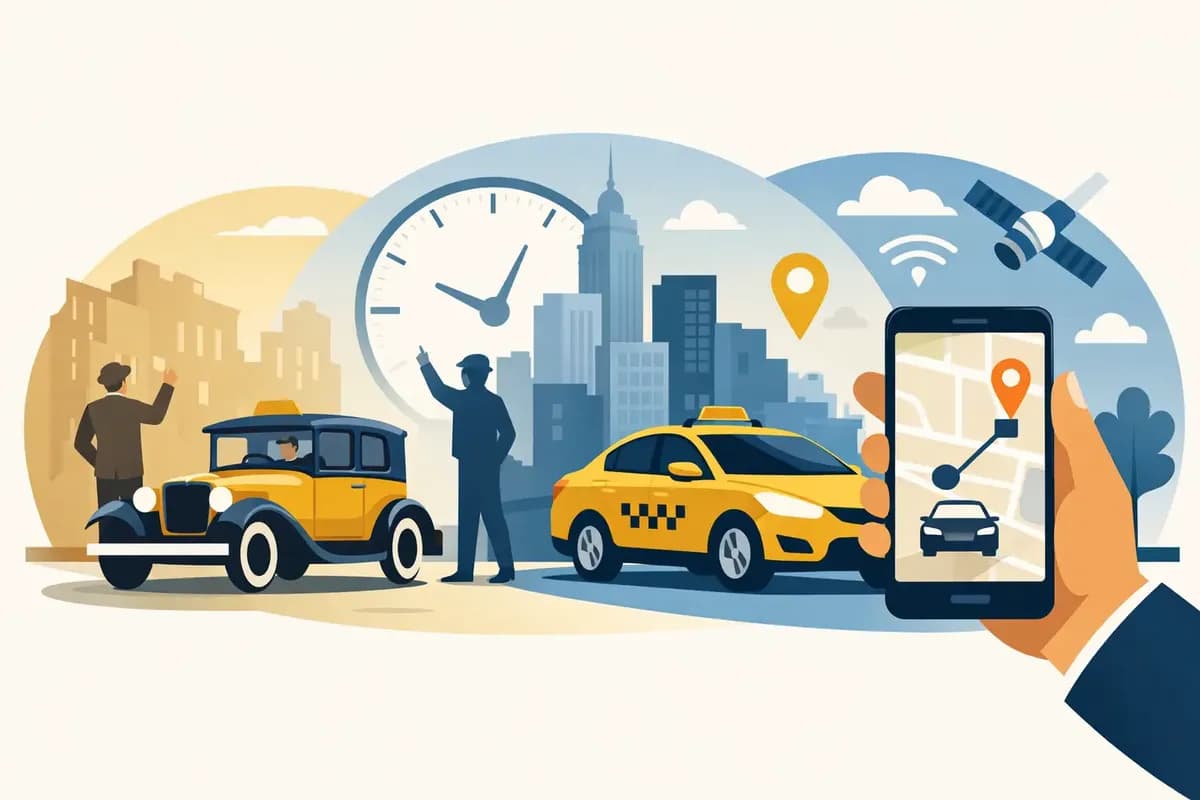
From street hails to live records
A taxi ride history used to be little more than a hand raised at the kerb, a short exchange with a driver and a paper receipt that was easily lost before the end of a holiday. For many passengers, the journey itself was the only record. That is changing: map-based booking, live vehicle tracking and the stored trip details in a modern Montenegro taxi app now make taxi travel easier to check, explain and manage — particularly when you are in an unfamiliar place.
The story matters because it shows why modern taxi apps are built around more than requesting a car. They answer the practical questions travellers have before, during and after a ride: where is the driver, which route was taken, what was charged and how can the trip be documented later?
Before apps: the early taxi journey
The modern taxi began with hired carriages, where passengers paid for a journey rather than owning the vehicle themselves. The key development was the taximeter, introduced in the late nineteenth century. It created a clearer way to calculate a fare using distance and, later, time — the word taxi itself comes from this device.
This was a major improvement on negotiating every journey from scratch. A visible meter gave passengers a reference point and helped drivers charge consistently. It did not remove every disagreement: passengers still needed to know where to find a licensed vehicle, understand local fare rules and trust that the route was reasonable.
By the early twentieth century, motor taxis were familiar features of growing cities. Taxi ranks outside stations, hotels and busy squares offered a reliable starting point, and street hails made short, spontaneous journeys possible. For locals who knew the area, the system often worked well.
For visitors, it could be less straightforward. A passenger arriving at an airport or cruise port might not know the local taxi rank, the usual journey time or the correct address to give. Language differences could turn a simple pickup into a series of directions, landmarks and phone calls.
Dispatch changed the taxi ride history
Radio dispatch brought the next big shift. Instead of waiting at a rank or hoping to hail a passing car, passengers could telephone a local taxi company. An operator recorded the pickup address, contacted an available driver and gave an estimated arrival time.
This made taxis more useful away from busy centres — in poor weather, late at night or with luggage. It also created a more formal record inside the taxi office, yet the passenger often had little visibility of it. They might be told a car was “on its way” without knowing the vehicle registration, the driver's exact position or whether the booking details had been passed on correctly.
Paper-based systems had other limits. Addresses could be misheard, and a hotel entrance, marina gate or old-town street might be difficult to describe. If a receipt was needed for work expenses, it depended on remembering to ask and keeping a small piece of paper safe.
Smartphones made location the starting point
The smartphone changed the booking process by putting a map in the passenger's hand. Rather than explaining a location from memory, a passenger can set a pickup point visually, add a destination and submit a request. The driver receives the same practical information in a format designed for navigation.
This is especially valuable where the road network, hotel entrances or coastal promenades are unfamiliar. A pin is not always perfect — a pickup point on the wrong side of a dual carriageway can still cause a delay — but it is usually clearer than describing your location over the phone.
The most meaningful change is that taxi ride history is no longer created only after the fare is paid. It begins the moment a passenger requests the car. The booking can show the selected pickup, destination, request time and assigned vehicle, and during the journey live tracking gives the passenger a clearer view of what is happening.
That visibility is useful rather than decorative. If you are outside a hotel in Budva, arriving at Tivat Airport or waiting near Kotor's old town, you can check whether the assigned vehicle is approaching the correct place. If availability is limited, the app can reflect the real situation instead of leaving you to wonder whether a phone request was received.
What a useful ride record should include
Not every trip history is equally helpful. A simple list of dates and prices is better than no record, but it may not be enough when a passenger needs to review a journey or submit an expense claim. The most useful trip information connects the booking, the route and the payment.
A clear record normally includes the pickup and destination, journey timestamps, fare details and payment information. A route map adds helpful context when several rides took place on the same day, and it can help a traveller recognise a trip made from an airport, restaurant or accommodation whose local address they did not remember.
For business travel, downloadable PDF receipts are particularly practical. A detailed receipt reduces the need to reconstruct a journey weeks later from a bank statement and a calendar: it can show when the journey took place, where it began and ended, how the fare was made up and how it was paid.
There is a balance to keep. Trip records should be easy for the passenger to access, while personal travel information should be handled carefully. A ride history is useful because it is specific, not because it is shared widely — passengers should be able to review their own completed journeys without turning routine travel into unnecessary exposure.
Why history still matters when booking is instant
Fast booking can make the record seem secondary. When you need a taxi in Montenegro after a late dinner, the immediate priority is finding an available licensed driver. But the information saved around that journey often becomes valuable later.
You may need to check the fare before splitting it with friends, confirm which entrance you were dropped at, repeat a successful route or retrieve a receipt for an employer. If something does not look right, accurate timestamps and journey details make it easier to ask a sensible question.
This is also where app-based services can improve confidence without making unrealistic promises. Driver availability depends on location, time and nearby online drivers. A good system does not pretend a vehicle will always appear instantly — it gives passengers clear booking details and live information once a driver is assigned.
For licensed drivers, digital records bring a similar benefit. Requests, active trips and completed work can be organised in one professional workflow — a practical improvement over relying on memory, loose notes or calls made while driving.
Taxi ride history for visitors in Montenegro
For international visitors, the value is often clearest on the first and last day of a trip. Arrivals at Tivat Airport can involve delayed flights, mobile data issues and unfamiliar pickup areas. A booking made in an app gives the passenger a reference point: the selected location, the trip status and, once assigned, the vehicle approaching on the map.
The same applies to journeys between accommodation, beaches, restaurants and nightlife venues. A traveller may not know the local spelling of a street, or may be staying at a property whose name appears more than once online. Saving the completed ride means the useful details are not lost after checkout.
Blic Taxi is designed around this straightforward approach: passengers can request a licensed local taxi, follow the assigned vehicle and review trip details afterwards. For work-related travel, the option of a downloadable PDF receipt with route information, timestamps, fare breakdown and payment details makes the record useful beyond the ride itself.
The next standard is clarity, not complexity
Taxi travel has moved from street hails and mechanical meters to phone dispatch, GPS navigation and live trip records. The technology is more advanced, but the passenger's basic need has stayed the same: get from the right place to the right destination with clear information along the way.
When choosing how to travel, look beyond the moment you press request. A dependable taxi experience should leave you with the details you may need afterwards — especially when your journey matters as much after arrival as it did at pickup.
Frequently asked questions
A useful record connects the booking, the route and the payment: pickup and destination, journey timestamps, fare breakdown and payment details, often with a route map that adds context when several rides happened on the same day.
Yes. With Blic Taxi you can download a PDF receipt with route information, timestamps, fare breakdown and payment details — practical for business expenses and for reviewing a journey weeks later without reconstructing it from a bank statement.
Once a driver is assigned, the app shows the vehicle approaching on the map, so you can check that it is heading to the correct pickup point — for example a hotel in Budva, the old town in Kotor or an airport pickup area.
No. Driver availability depends on your location, the time of day and how many licensed drivers are online nearby. A good app does not promise instant cars — it shows the real situation and gives clear booking details and live tracking once a driver accepts.