
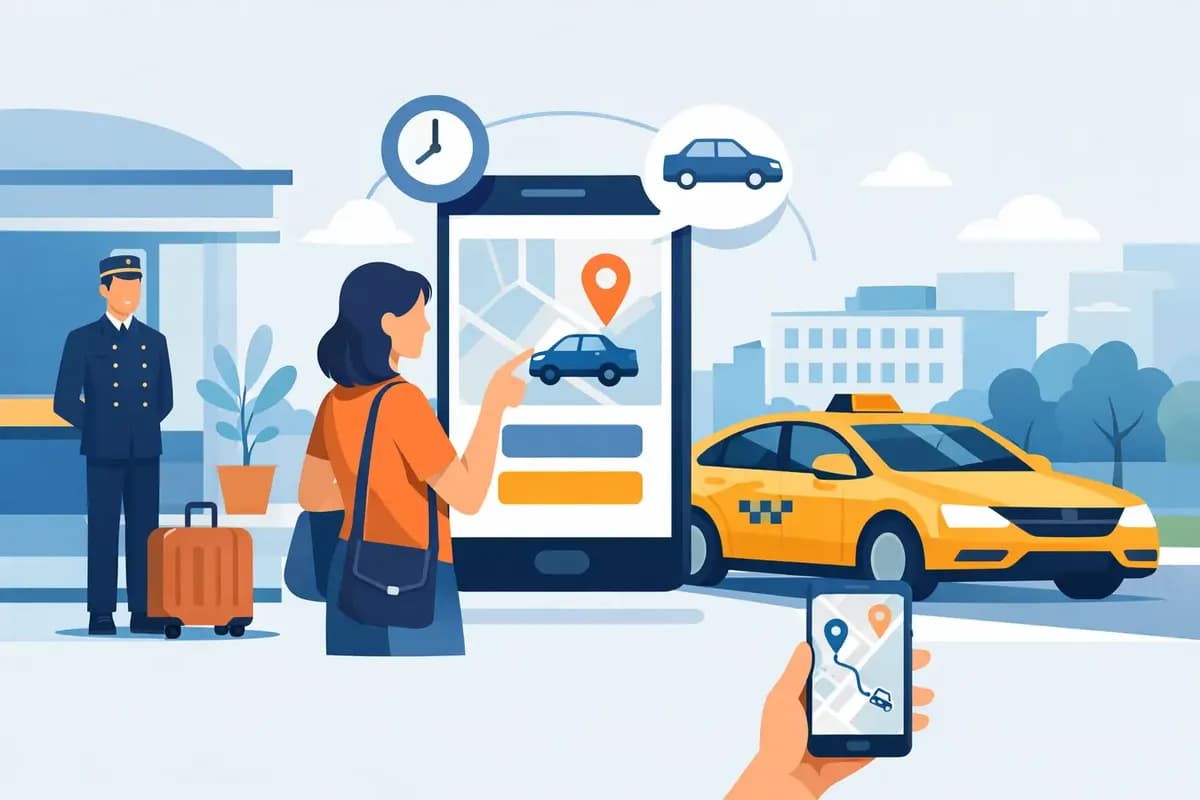
Why the hotel address is not always enough
A hotel address is not always a useful pickup point. Large resorts can have several gates, historic-town hotels may sit on pedestrian streets, and a driver may need to meet you at a nearby road rather than the lobby door. That is why taxi booking for hotel guests works best when the booking process lets you see and adjust the pickup location before the car arrives.
For visitors, this removes a common travel problem: explaining where you are to a local dispatcher when you do not know the area or speak the language. For hotel teams, it means fewer calls, fewer misunderstandings and clearer expectations for guests heading to the airport, dinner, a marina or their next accommodation.
Why hotel pickups need more than a reception call
Reception teams are helpful, but a phone booking can leave important details unclear. Is the taxi coming to the main entrance, the beach gate or the side road? How long will it take? Which vehicle should the guest look for? And if plans change, who needs to be called?
A map-based booking app gives the guest direct control over those details. They can set the pickup point, add the destination and submit the request themselves. Once a driver accepts, live vehicle tracking shows the car approaching, so the guest can be ready at the agreed collection point rather than waiting in the lobby without an arrival update.
This is particularly useful in Montenegro's busier coastal locations, where summer traffic, narrow streets and one-way systems can make a hotel entrance less straightforward than it appears on a map. It is also useful for hillside properties, private villas and hotels within old towns where vehicles have limited access.
Taxi booking for hotel guests in three practical steps
The first step is to set the pickup point precisely. Open the app while connected to the hotel Wi-Fi or mobile data and place the pickup pin where the vehicle can realistically stop. Do not assume the hotel name alone will identify the correct entrance.
Check the map against your surroundings. If there is a main driveway, use that. If the hotel is inside a pedestrian zone, select the nearest accessible road and arrange to walk there. A short note such as “main gate” or “by reception entrance” can help where the booking flow allows it, but the map pin is the key detail.
For larger resorts, it is worth asking reception which entrance taxis normally use. This takes seconds and can prevent the driver and passenger waiting at opposite ends of the property.
The second step is to add the destination before requesting. Enter your destination before sending the request. This gives the driver the journey context and allows you to review the trip details in one place.
For airport transfers, use the airport terminal as the destination rather than a general town name. For restaurants, beach clubs or attractions, check the pin is on the correct side of the road. In places such as Kotor Old Town or Budva's historic centre, it may be more practical to select a nearby vehicle access point than a venue inside the pedestrian area.
If you are travelling with luggage, pushchairs or a larger group, make sure the vehicle shown is suitable before you set off. App-based booking makes the request clearer, but it cannot change the physical limits of a car. When in doubt, ask the hotel about the most appropriate pickup location and allow extra time.
The third step is to follow the assigned vehicle live. After a licensed local driver accepts the request, use the live map to follow the vehicle's approach. Check the vehicle information in the app before getting in, especially outside a busy hotel or airport where several taxis may be waiting.
Live tracking is useful for more than reassurance. It helps you judge when to leave your room, collect luggage or finish checking out. If the driver is delayed by traffic, you can see that rather than wondering whether the request has been missed.
Driver availability depends on your location, the time of day and the number of nearby drivers online. During peak arrivals, major events, heavy rain or late-night periods, request your ride with enough time to spare. A booking app offers clear visibility, not a guarantee that a vehicle will always be immediately available.
Make airport journeys less stressful
A hotel-to-airport ride is often the journey people cannot afford to get wrong. Flights have fixed departure times, roads can be busy, and guests may be travelling with bags after a long stay. The practical answer is to set the destination carefully, request the ride early and use the live map to monitor its arrival.
Allow time for hotel check-out, loading luggage and the drive itself. Reception can advise on local traffic patterns, but the guest should still keep control of the ride request and vehicle details in the app. This is especially helpful when leaving early, when fewer staff may be on duty, or when the hotel is some distance from the main road.
The same approach works in reverse. After arriving at an airport, set your pickup point at the designated taxi collection area or a clear nearby landmark, then track the assigned car. Avoid trying to describe your exact position over the phone while managing bags, travel documents and an unfamiliar terminal.
What hotel guests should check before leaving
A good pickup is usually decided before the driver is on the road. Take a moment to confirm four things: the accessible pickup point, the destination pin, the number of passengers and the time you need to arrive.
If you have a very early flight, a dinner reservation or a connection to catch, build in a buffer. The best timing depends on distance, traffic and local conditions. In high season, a short route on a map can take longer than expected, particularly around popular coastal areas.
Keep your phone charged and notifications enabled. If the app shows a driver has arrived but you cannot see the vehicle, compare the live location with your actual position before moving. Hotels often have similarly named entrances, car parks and drop-off zones.
Clear trip details for business travellers
For business guests, transport is not finished when the car stops. They may need a record of the route, timestamps, fare and payment information for an expense claim. A downloadable PDF receipt gives them that documentation without relying on a paper slip that can be lost between the hotel, meeting and airport.
Blic Taxi provides trip records with route maps, fare breakdowns and payment details, helping travellers keep their journey information organised. This is useful for a one-off client visit, but it becomes particularly valuable for people making several local journeys during a stay.
A digital record also gives travellers a simple history of completed rides. If you need to check when you left the hotel, confirm the route taken or prepare expenses after returning home, the details are already in the app.
When reception support still matters
Self-service booking does not mean hotel staff have no role. Reception remains a useful source of local knowledge. They can point out the correct taxi entrance, explain whether cars can access the property, suggest when to leave for an airport and help guests who are less comfortable with mobile apps.
The difference is that the guest does not need reception to act as a go-between for every journey. They can manage pickup and destination details directly, see the vehicle live and retain their own trip history. That independence is valuable for international visitors, particularly when plans change after reception has closed or while they are away from the hotel.
A better start to every journey
The easiest hotel taxi ride begins with an accurate pin, not a rushed call from the lobby. Set the accessible pickup point, check the destination, watch for the assigned vehicle and give yourself time when the journey matters. A few clear details turn a potentially uncertain transfer into a journey you can follow from the moment you request it.
Frequently asked questions
Place the pin where a vehicle can realistically stop — the main driveway if there is one. If the hotel is in a pedestrian zone, choose the nearest accessible road and walk there. For larger resorts, ask reception which entrance taxis normally use.
Yes. Set the airport terminal as your destination, request the ride early and follow the car on the live map. Allow time for check-out, luggage and the drive itself, and build in a buffer for flights that cannot be missed.
Compare the vehicle's live location with your actual position before moving. Hotels often have similarly named entrances, car parks and drop-off zones, so the car may be waiting at another gate. Check the vehicle details in the app before getting in.
Yes. Blic Taxi provides downloadable PDF trip records with route maps, fare breakdowns and payment details, so you can prepare expense claims without relying on a paper slip. The app also keeps a simple history of your completed rides.