
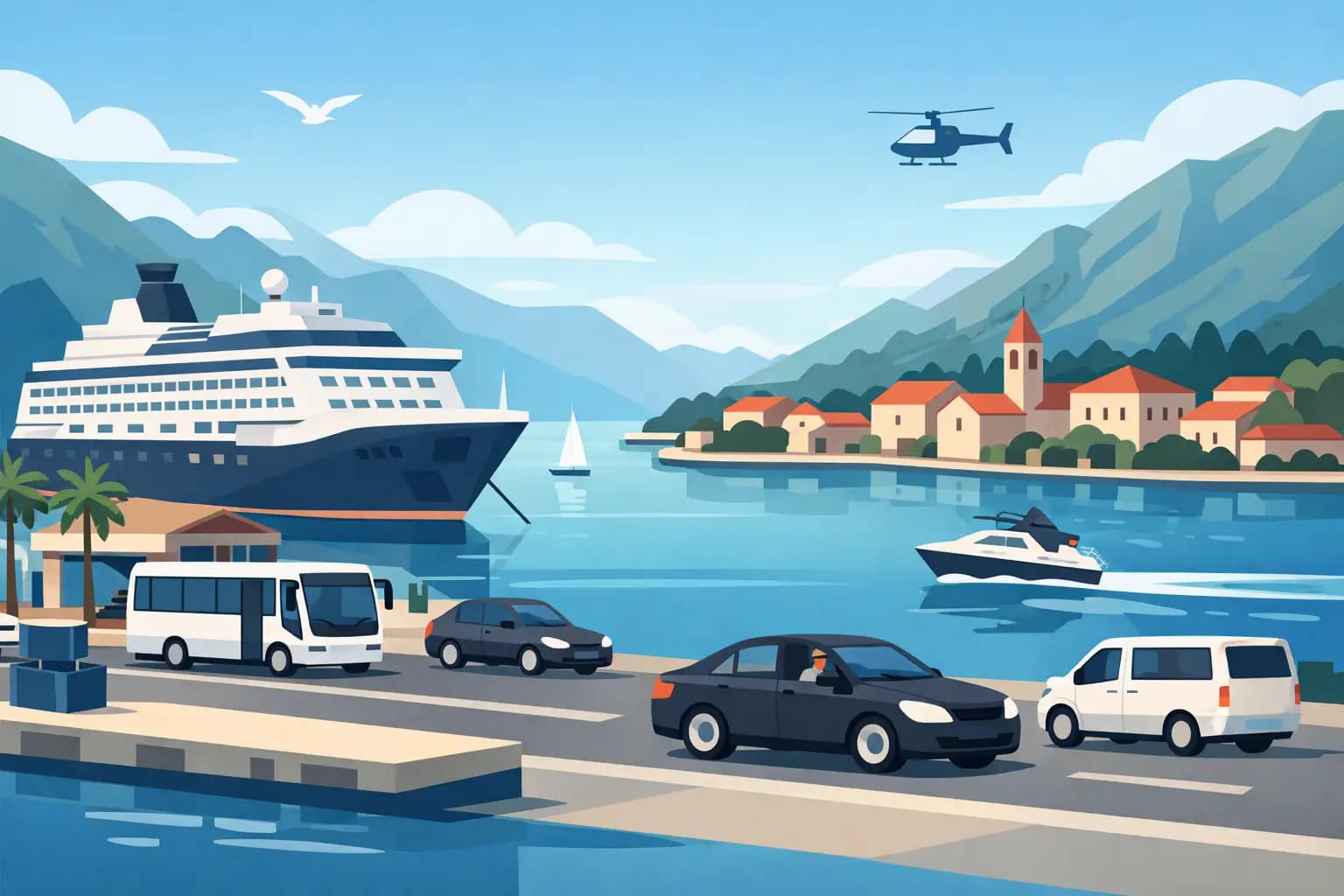
Cruise days in Kotor and Bar: where the pinch points are
A cruise day in Montenegro can feel gloriously simple until thousands of passengers reach the quayside at once. This Montenegro cruise terminal transport guide explains where the real pinch points are, how to arrange a pickup without guessing, and when a taxi is the better choice than an organised excursion.
The two ports most cruise visitors use are Kotor and Bar, but they work very differently. Your best transport plan depends on whether your ship is alongside or at anchor, how long you have ashore, the size of your party, and whether you want to stay close to the coast or travel further inland.
Montenegro cruise terminal transport guide: start with your port
Before booking anything, check the port named on your cruise itinerary rather than relying on a tour description. Kotor and Bar are a substantial distance apart, and transport options, journey times and meeting arrangements are not interchangeable.
Kotor is the most common stop for visitors drawn to the Bay of Kotor, the Old Town and nearby Perast. It is also the port where timing deserves the most attention. Larger ships may use tenders, meaning passengers are brought ashore by smaller boats. In that case, your stated arrival time is not necessarily the time you will be outside the port gate.
Bar is a working Adriatic port with a different layout and a less immediate Old Town experience. It can be a practical starting point for Stari Bar, the Skadar Lake area, Ulcinj or the coast towards Budva. If your ship calls at Bar, do not book a Kotor-based meeting point simply because Kotor appears in most Montenegro travel guides.
A taxi works particularly well when you want a direct journey, have luggage, are travelling with children, or want the freedom to choose your own stop. It is less suitable if you only have a short port call and are planning a long, multi-stop route with no margin for traffic. In that situation, a cruise-line excursion may offer more protection if timings change.
Plan for the moment you actually reach land
Set your pickup time around disembarkation, not the ship's arrival. For an alongside berth, allow time to walk down the gangway, pass through the port area and find the public exit. For a tender operation, allow considerably more flexibility, especially if you are not among the first passengers called ashore.
Use a precise pickup point. "Kotor port" is too broad on a busy cruise morning. Look for the designated passenger exit, a clearly named gate, a nearby hotel entrance or a recognisable public landmark outside the restricted terminal area. Drivers may not be able to enter every port-controlled zone, so the most convenient meeting point is often just beyond it.
A map-based booking app is useful here because you can place the pin where you are standing rather than trying to explain a street name over the phone. Once a driver accepts, live vehicle tracking lets you see whether they are approaching from the Old Town side, the waterfront or a busier road. With Blic Taxi, passengers can set the pickup point, follow the assigned vehicle and manage trip details in the app.
Keep mobile data available before leaving the ship. Port Wi-Fi can be slow when a large number of passengers connect at once, and a saved screenshot of your meeting point is a sensible backup. If you are travelling as a group, nominate one person to communicate with the driver so that arrival instructions do not become confused.
Kotor: allow extra time around the Old Town. Kotor's cruise setting is memorable, but its compact waterfront and narrow streets can become congested quickly. The Old Town lies very close to the harbour, so visitors who are only walking around the historic centre may not need transport immediately. If you are heading to Perast, Tivat, Budva, Lovćen or a hotel elsewhere on the coast, arrange your onward ride after you have cleared the busiest pedestrian flow.
Do not assume a vehicle can collect you directly beside every landmark inside the Old Town. Some streets are pedestrian-only, while nearby roads may be temporarily crowded with coaches, taxis and excursion groups. A short walk to an agreed road-accessible point can make the collection quicker for everyone.
For Perast, a taxi gives you the option of travelling at your own pace and stopping for photographs on the bay road where safe and permitted. The trade-off is that the route can be slow in peak summer traffic. If your ship sails in a few hours, build in generous time for the return journey and aim to be back near the port well before the all-aboard time.
Travellers considering a trip up to Lovćen or Cetinje should be especially realistic. The mountain roads are scenic, but they are not a quick out-and-back add-on to a short Kotor call. Weather, traffic and the pace of your visit all matter. For a limited port day, choose fewer places and leave time to enjoy them.
Bar: choose a destination before you leave the terminal. At Bar, decide whether you want heritage, beach time or an inland day out. Stari Bar is a strong choice for visitors interested in a historic fortified town, while the coast south towards Ulcinj suits those looking for longer beaches and a different atmosphere. Skadar Lake can also be appealing, but journey timing should be checked carefully against your ship schedule.
The modern port and town are more spread out than Kotor's compact visitor area. That makes a pre-planned destination and a clear return pickup particularly useful. If you are splitting from friends, make sure each group has its own confirmed meeting arrangements rather than expecting to find one another at the terminal later.
Match your transport to the day you want
A direct taxi is the straightforward option for a hotel transfer, a restaurant booking, a beach visit or a one-way journey to another coastal town. It also gives couples and families more privacy than waiting for a shared coach, and it removes the need to work out local bus stops with limited time ashore.
For a self-directed half-day, keep the route focused. From Kotor, that might mean Perast and the bay rather than Perast, Budva, Lovćen and Cetinje in one rushed circuit. From Bar, it could be Stari Bar followed by a return to the ship, rather than trying to add several distant coastal stops.
If you want a driver to wait while you visit multiple places, establish that requirement before the journey begins. A standard point-to-point booking and an hourly or multi-stop arrangement are different services. Be clear about your planned stops, how long you expect to spend at each one, and the time you need to return to the terminal.
Book with details, not assumptions
Enter the pickup pin, destination and any useful notes while you still have a stable connection. If your group has several cases, a pushchair or other bulky items, say so in advance. The right vehicle size cannot be assumed from the number of passengers alone.
Check the trip information before setting off. A digital booking gives you a record of the route, ride timing and payment details rather than leaving you to rely on a verbal arrangement. Availability, however, always depends on your location, the time of day and nearby drivers who are online. Cruise arrivals create sudden demand, so booking as soon as you are ready to travel is wiser than waiting until the whole quay is busy.
For the return, use a location that is easy to identify from the road. If you are visiting Perast, for example, agree a practical roadside collection point rather than a vague instruction to meet "by the water". In mountain or rural areas, allow for weaker signal and confirm your plan before you start exploring.
Keep your ship timetable in control
The ship's all-aboard time is your non-negotiable deadline, not the advertised sailing time. Set a personal return target well before it, particularly if your route includes mountain roads, summer coastal traffic or a border-area destination. Montenegro rewards unhurried travel, but a port call is not the day to test how quickly a road clears.
Save your ship's name, berth or tender point, and the terminal address if one is provided. When you return, follow port staff instructions rather than assuming you can be dropped at the exact place you left from. Security arrangements and traffic access can change during the day.
A good cruise day leaves room for an unplanned coffee on the waterfront, a longer look at the bay or a quiet walk through an old stone street. Arrange the practical parts clearly, leave a return buffer, and let the time ashore feel like Montenegro rather than a race back to the ship.
Frequently asked questions
Choose a clearly identifiable spot just outside the port-controlled area — a named gate, the designated passenger exit or a nearby hotel entrance — rather than a general "Kotor port" pin. Drivers may not be allowed inside every port zone, so the most convenient meeting point is usually just beyond it.
Perast is close to Kotor, but the bay road can be slow in peak summer traffic. If your ship sails within a few hours, build in a generous buffer for the return journey and aim to be back near the port well before the all-aboard time rather than the advertised sailing time.
Yes. Set the pickup pin at an accessible point outside the terminal, add your destination — Stari Bar, Ulcinj or a coastal town — and follow the assigned vehicle live. Availability depends on the time and how many licensed drivers are online nearby, so request as soon as you are ready to travel.